
What is kinetic art? A closer look at art that moves
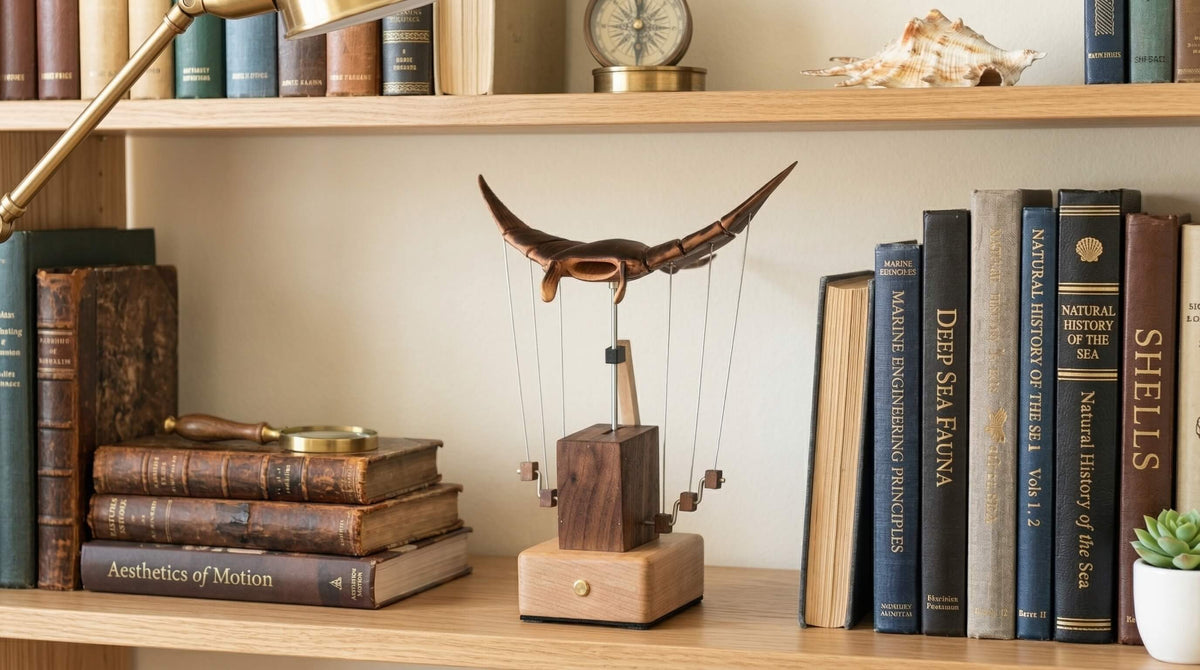
With kinetic art, movement is part of the work. Looking becomes something that unfolds over time.
A sculpture usually holds a pose. A kinetic sculpture changes one. Its movement might be barely perceptible or immediately expressive, but time becomes part of the experience: you see a rise, a turn, a pause, and the beginning of the next cycle.
Movement can come from different places.
Some works respond to air currents. Others use a hand-operated mechanism or an electric motor. A moving object and an optical illusion are not quite the same thing, even though both can change how we experience a form.
In the Wilderturn collection, our kinetic wooden creatures use mechanical movement. Most use USB-C power or rechargeable batteries; the swan uses an AAA battery. The carved wave artworks are static pieces. The product page explains which kind you are looking at.
Why watch a repeating movement?
A rhythm invites you to notice details that a still image can miss. You might follow the relationship between a turning wheel and a sweeping wing, or watch how the shape of an animal changes as its joints move. Knowing that there is a mechanism does not remove the pleasure of seeing it work.
Choose for the room, as well as the shape.
Consider where the piece will live. Moving parts need clearance, and a stable indoor surface matters. Natural wood should be kept away from moisture and direct heat. Motors and gears may be audible; a version without music is not necessarily completely silent.
Look at dimensions instead of relying on the photograph. A small reading figure and a broad-winged dragon can occupy very different amounts of space. If you are choosing a gift, think about the recipient’s shelf or desk before deciding.
Start with a creature that means something.
The Gliding Manta Ray offers a slow, sweeping form. The Running Horse makes the coordination of articulated joints part of its character. The Acorn Scholar turns a bookish personality into a small moving figure.
There is no single right way to enjoy kinetic art. Watch the mechanics, follow the silhouette, or simply let an ordinary room contain something a little unexpected.